
Collin County Court Records After a Jail Arrest
After a Collin County arrest, the jail record and the court record are related, but they are not the same record. The jail side begins with booking at the Collin County Detention Facility, operated by Sheriff Jim Skinner's Collin County Sheriff's Office, or, for some municipal arrests, a city jail such as Plano, Frisco, or Allen. That custody record can show the person, booking status, mugshot where available, time served, bond amount, and initial booking charges. The court record becomes clearer when prosecutors and clerks process formal charges into a case.
The Collin County Case Information page describes the county's Online Judicial Search as a way to review court cases by name, case, or citation number, look up current inmates, view mug shots, check bonds and time served, link inmates back to criminal cases, and check active warrants. Use jail inmate records for custody and roster details. Use jail mugshots for booking photos. Use the court record for filed charges, court events, disposition, and formal case status.
How to Find Collin County Court Records After an Arrest
The main local entry point is Collin County's Judicial Online Search. It is not just a jail roster. County materials describe it as a justice-system search portal for current inmates, court cases, active warrants, bond amounts, time served, mugshots, and linked criminal cases. That matters after an arrest because a person may appear first as a current inmate, then later through a case search after the clerk and prosecutor have processed filings.
- Open the county Judicial Online Search from the Case Information or inmate-information page.
- Search by defendant name if no case number is available. For traffic or citation-driven matters, try citation number.
- Open the case result and compare the case number, defendant name, court, and charge list against any jail profile or bond paperwork.
- Check each charge separately. One arrest can produce multiple charges, and each charge can have a different bond, status, or outcome.
- If the case is not online, route the request to the correct clerk rather than assuming the jail can supply the court file.
Collin County separates search paths by court record type. Case Search covers active cases in District Courts, County Courts at Law including Probate, and Justice Courts. It also includes historical Justice Court cases from 1984 forward, historical civil District and County Court at Law cases from 1984 forward, historical Probate County Court at Law cases from 1984 forward, historical Criminal District Court cases from 1988 forward, and historical Criminal County Court at Law cases from 2000 forward. Case Search updates daily at 6 p.m. Case Record Inquiry can update in real time, but the county says it searches one case type at a time.
| Search Field or Mode | Type | Required | How It Helps After Arrest |
|---|---|---|---|
| Name | Text | Optional or unspecified | Useful when only the defendant's name is known from a jail profile, bond sheet, or family notice. |
| Case Number | Text | Optional or unspecified | Best for narrowing a filed criminal case once the number appears in court, warrant, or bond paperwork. |
| Citation Number | Text | Optional or unspecified | Helpful for traffic, Justice Court, municipal, and citation-driven matters. |
| Case Search | Search mode | Unspecified | Searches all case types simultaneously and updates daily at 6 p.m. |
| Case Record Inquiry | Case-type path | Case type required | Searches one selected case type at a time and updates in real time. |
| Court Calendar | Calendar path | Case type required | Checks scheduled hearings once the correct case type has been selected. |
| Judicial Officer | Filter | Conditional | Used for certain calendar searches, including the county's probate calendar instruction. |
The county's case-information screen is a useful orientation point before moving into the portal. The official page at collincountytx.gov/services/case-information explains Case Search, Case Record Inquiry, court calendars, update timing, active and historical coverage, and links related to inmates, mugshots, warrants, and bonds.
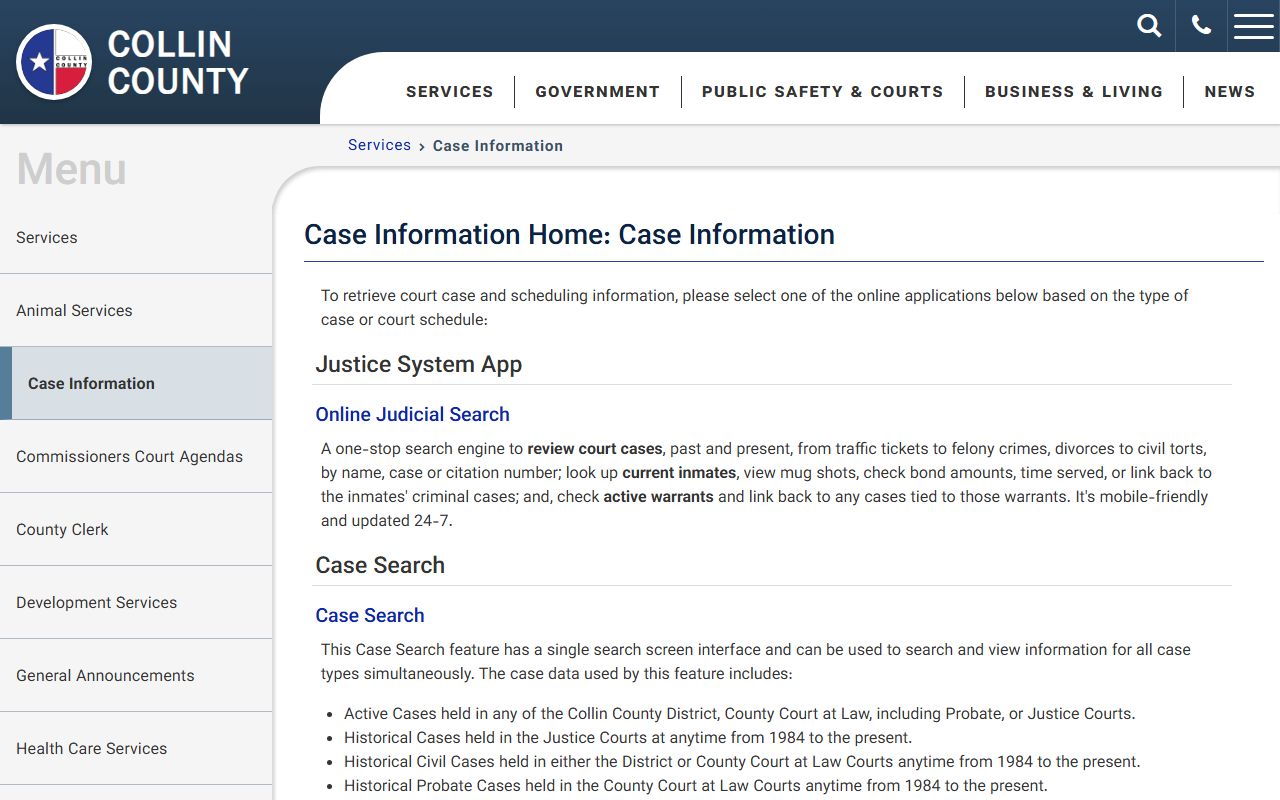
That county page also makes one practical distinction clear: court-search timing is not identical to jail-roster timing. A booking can be visible before formal court records after a jail arrest are fully filed, while same-day case changes may not appear in Case Search until after the daily update.
How Charges Get Filed After an Arrest: Complaint, Information, and Indictment
Booking charges are the starting point, not always the final prosecution decision. In Collin County, the Collin County Criminal District Attorney, Greg Willis, prosecutes felony and many misdemeanor criminal matters. Police and jail paperwork begin the custody trail, then the prosecutor reviews the evidence and decides whether to accept, reject, amend, reduce, enhance, dismiss, or present charges through the proper Texas procedure. Felony cases usually route through District Court records, with the District Clerk as custodian. Many misdemeanor matters route through County Courts at Law or other appropriate court paths.
| Document | Who Files or Initiates It | Common Use | What to Check in the Court Record |
|---|---|---|---|
| Complaint | Officer, prosecutor, or authorized complainant depending on case type | Initial accusation and lower-level criminal matters | Name, offense date, alleged offense, court, and whether later filings replace or supplement it. |
| Information | Prosecutor | Misdemeanors and some felony procedure contexts where allowed | The formal charge wording, count number, statute reference, and any amendment. |
| Indictment | Grand jury | Many felony prosecutions | Returned charge, count structure, enhancement language, arraignment setting, and later disposition. |
The District Clerk page states that the clerk is the registrar, recorder, and custodian of pleadings, filings, and court records for Collin County District Courts. For historical criminal District Court searches before 1988, and civil searches before 1984, the District Clerk requires an in-person, mail, or email request using the District Clerk Record Request Form. The research source lists a $5 search fee, asks for the person's complete name and date of birth, and states that searches are normally processed within one or two days of receipt. The office does not provide record searches by phone.
Charge Status in Court Records After a Jail Arrest
Charge status changes as a case moves from arrest to prosecution. A jail profile may show the booking charge and bond. The court record may later show a different filed charge, an amended count, a reduced offense, a dismissal, or a final judgment. The safest way to read court records after an arrest is to treat every count separately and avoid assuming that one case outcome applies to every charge.
| Status | What It Means | Why It Matters |
|---|---|---|
| Pending | The charge has been filed or is still moving through court without a final disposition. | Bond, hearings, warrants, and conditions may still change. |
| Amended | The prosecutor or court record changed the charge wording, count, statute reference, or allegation. | The filed court charge may no longer match the jail booking charge. |
| Reduced | The prosecution moved forward on a lesser offense than the original or earlier charge. | Case level, penalties, bond, and plea terms may differ from the arrest entry. |
| Dismissed | The court record shows the charge was dismissed or not pursued to judgment. | A dismissal is not the same as automatic removal from every public record. |
| Nolle prosequi or not prosecuted | The prosecutor declined to continue a charge, where that wording appears in the record. | It may support cleanup options, but eligibility depends on Texas law and the exact disposition. |
| Disposed | The charge has a recorded outcome, such as conviction, acquittal, dismissal, deferred adjudication, or other final action. | The disposition, not the booking entry alone, is the key court-record result. |
Bond and Release After an Arrest
Collin County's inmate-bonds page says the Sheriff's Office accepts cash or surety bonds at 4300 Community Avenue, McKinney, TX 75071. The county defines bail as security given by an accused person to appear before the proper court and answer the accusation, and bond as the written agreement by the defendant or sureties that the defendant will appear while at liberty. The bond amount visible in jail or court lookup tools should be checked against all charges and holds before assuming release is available.
| Bond Type | How It Works | Local Caution |
|---|---|---|
| Cash Bond | Money is posted directly, usually for the full amount, at the jail or court channel. | County research confirms cash bonds are accepted at 4300 Community Avenue. |
| Surety Bond | A licensed bonding company or surety posts the bond for the defendant. | County research confirms surety bonds are accepted at the same jail address. |
| Personal Bond or PR Bond | The defendant is released on a written promise to appear, often with conditions. | Availability depends on court order, charge, history, and local procedure. |
| No-Bond Hold | Ordinary bond posting will not release the person because of a court order, new charge, detainer, parole matter, federal hold, immigration hold, or another agency hold. | A paid bond on one Collin County case may not clear another warrant or hold. |
Do not confuse bond payments with commissary deposits. The research notes that cash deposited for inmate commissary uses inmate-account channels, while Bonds accepts cash for bonding purposes only. Before posting, confirm the inmate is still in Collin County custody, confirm every listed charge, and check whether another agency hold remains active.
Warrants That Lead to Court Records and Arrest
Collin County's Case Information page says the Judicial Online Search can check active warrants and link them back to any related cases. That makes the warrant path part of the same court and custody workflow. An arrest warrant, bench warrant, capias, capias pro fine, fugitive warrant, or other-agency warrant can all affect whether a person is booked, how bond is set, and whether release is delayed after a local bond is posted.
Search by name first when no case number is known, then use case number or citation number if the warrant is connected to a known court matter. For municipal warrants, the city court or city police department may be the correct custodian, especially for Class C matters. A person with a possible warrant should confirm options through the court, an attorney, or a bonding professional before appearing in person, because the practical choices may include bond, a court appearance, a payment plan, or a recall or quash order.
Charges vs. Convictions in Collin County Court Records
An arrest and a charge are accusations. A conviction is a court outcome. Collin County court records after a jail arrest may show pending charges for weeks or months before any final result, and one case can contain both dismissed counts and convicted counts. Read the disposition field, judgment entries, plea information, and sentence terms before describing a case as a conviction.
| Charge | Conviction | |
|---|---|---|
| Stage | Accusation after arrest, prosecutor filing, complaint, information, or indictment. | Final guilty finding, plea, or judgment entered by the court. |
| Proof Level | Based on probable cause or prosecutorial filing standards. | Requires proof beyond a reasonable doubt or a valid guilty or no-contest plea. |
| Record Meaning | Shows what was alleged and how the case began or changed. | Shows the court's final criminal responsibility finding for that count. |
| Public Access | Often public unless restricted by law, juvenile rules, sealing, expunction, or court order. | Often public unless restricted by law or court order. |
| Common Mistake | Treating a booking charge as a proven offense. | Ignoring dismissed or reduced counts in the same case. |
Sealed vs. Expunged Arrest Records and Court Records
Texas record cleanup depends on the exact charge, disposition, waiting period, and court order. Texas Code of Criminal Procedure Chapter 55 governs expunction of qualifying arrest and case records. Nondisclosure and sealing are separate concepts that can limit public access without treating the event as if it never existed. A dismissal in Collin County does not automatically erase every jail, police, court, or commercial copy of the information.
| Sealed or Nondisclosed | Expunged | |
|---|---|---|
| Public Visibility | Restricted from many public searches after a qualifying court order. | Removed, destroyed, returned, or treated under the expunction order as though the arrest did not occur. |
| Agency Access | Some criminal justice, licensing, or legally authorized access may remain. | Access is very limited and controlled by the expunction order and Texas law. |
| Best Fit | Often associated with eligible nondisclosure outcomes, including some deferred adjudication paths. | Often associated with eligible acquittals, dismissals, no-charge outcomes, pardons, or identity-mistake situations, depending on the statute. |
| Practical Step | Get the signed order and provide it to the custodian if public access still appears. | Get the signed order and make sure every listed agency received and processed it. |
Official Collin County records follow the custodian. Court records route to the District Clerk, County Clerk, Justice Court, or municipal court, depending on the case. Police records, arrest reports, jailings, 911 calls, and accident reports route to the agency that created them. The county's public-records routing page is direct about that separation.
Background Check Considerations
Casual court lookup is not the same as an FCRA-compliant background check. Employers, landlords, insurers, lenders, and other regulated decision makers have separate legal duties for consumer reports, adverse action notices, permissible purpose, and identity matching. A public case search can help a reader understand a court file, but it should not be used as a substitute for a compliant screening process.
Important: Collin County Inmate Population is not a consumer reporting agency, and its information may not be used for FCRA-covered decisions.
Restricted Court Records After an Arrest in Collin County
Not every arrest-related record is public, complete, or permanently online. Texas Government Code Chapter 552 gives the public a general right to request existing government information, but exceptions can apply. Juvenile information, sealed or expunged cases, confidential victim information, certain active law-enforcement records, medical or mental-health details, and court-restricted documents may be withheld or redacted. Booking photos and jail records are not guaranteed permanent online content.
Use the correct custodian for the record type. District Court felony filings route to the District Clerk. County Court at Law criminal matters route through county court or clerk channels. Justice Court and municipal matters may require the specific court. Police reports, arrest reports, jailings, 911 calls, and accident reports belong to the agency that created or received them. For existing county-government records, Collin County provides an online Public Information Request portal, but misrouted requests may need to be redirected.